|
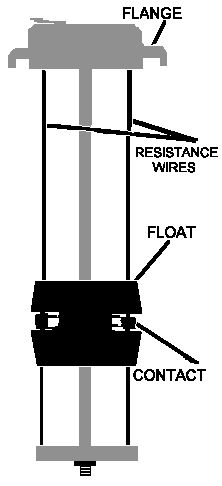
For some time the Fastback's fuel gauge had been suddenly jumping to a higher or lower reading, and knowing I had a spare tank sender unit if anything went wrong, I removed and dismantled the faulty one by flattening the locking washer on the bottom, unscrewing the nut and carefully pulling off the aluminium tube. What was revealed was far simpler than I had imagined; two thin resistance wires are supported by a central rod, and the float simply runs up and down as the fuel tank fills or empties, allowing a double ended contact to short the two wires together. This results in their total resistance varying according to the float position. The more usual design of tank sender unit has a sweeping contact attached to the float arm, that eventually wears away the finely-wrapped resistance wire; no wonder these tubular senders are generally fairly trouble-free. A careful clean with some T-cut removed surface gum from the wires and contacts, allowing a smooth change of resistance as the float was moved up and down. It seems to have done the trick, and is one more useful thing learned about the model. There may well be a small adjuster somewhere on the gauge to 'tune' the sender to the gauge, but I haven't bothered to look for it yet. Take great care with the wire as if the wire gets
broken, you will find it hard to replace it. It needs to
be about 100 ohms total resistance, which works out about 330 ohms per metre Type 4s have a similar tubular fuel sender, but it is deeper, and some models of Bus have a deeper tank sender unit, so is unsuitable for Type 3s or Type 4s.
|
|
| Fuel Sender
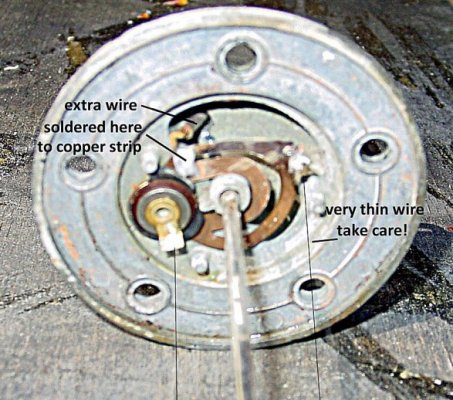
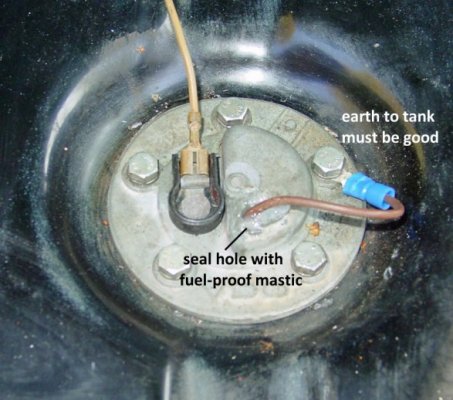
Repair A club member sent in these photos of a repair he had to do when continuity from the wire to the body was lost. It may be possible to cure this another way, but it seems likely that corrosion between the copper and alloy body caused the problem, and it wouldn't be easy to clean up the contact surfaces. |
|
 |
|
|
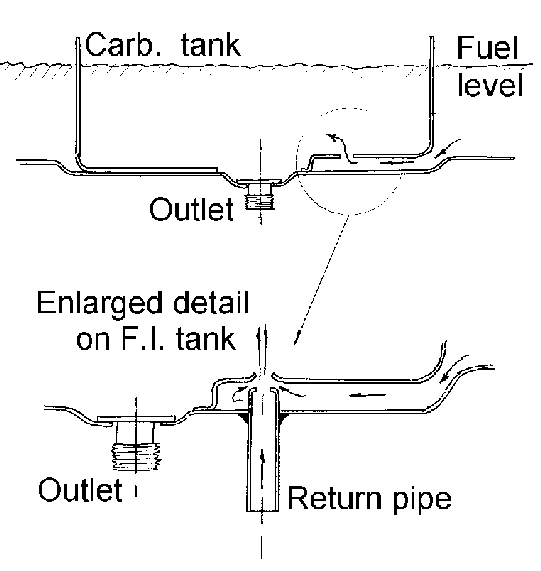
Fuel Tank Detail From Geoff Tunks comes this useful picture on what's inside the fuel tank. There's a sort of venturi effect to jet fuel back into the inner cup/reservoir so it can use the last from the tank and cannot suck in air until the fuel has gone. It helps explain why rust debris or thick tank-coatings can cause problems, apart from blocking filters. If you have a lot of dirt in the tank or filter, it may be due to a cracked filler vent pipe, a J-shaped 12mm bore rubber hose fitted to cars with the external filler door. Simon Kelley, notch1500 on ebay, has them at a reasonable price and good quality.
|
 |
|
Return to : Type 3 & 4 Club homepage or Technical Topics (c) VW Type 3 & 4 Club; October 1997 |
|
 Fuel Sender
Exposed! by Dave Hall
Fuel Sender
Exposed! by Dave Hall